
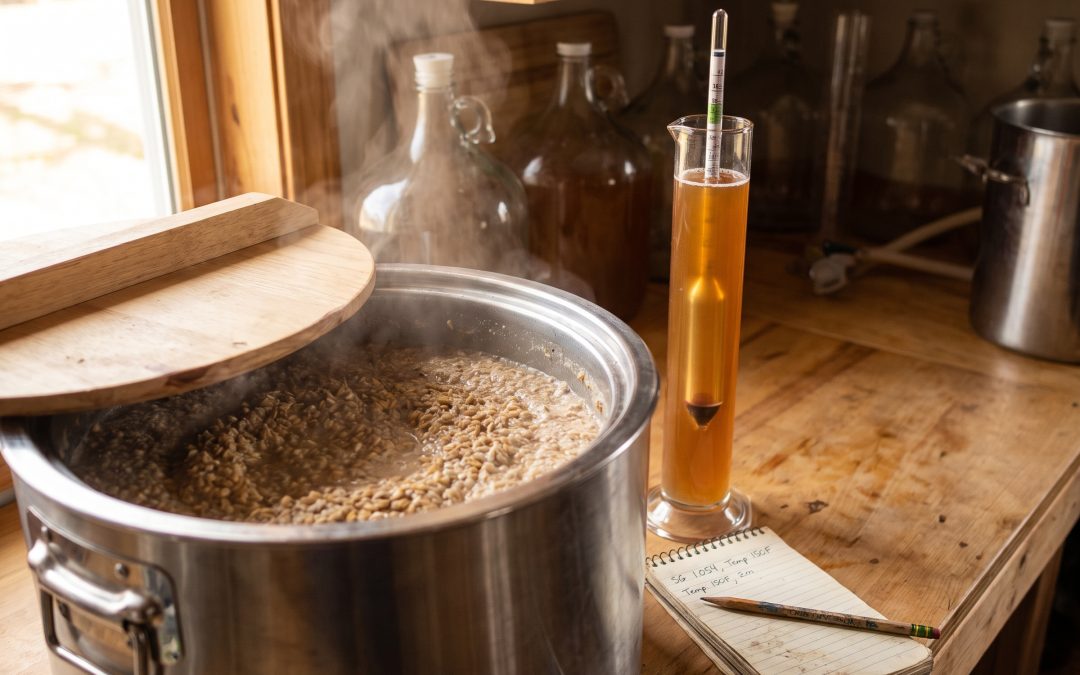
Brewing efficiency tells you how much of the sugar in your grain actually ends up in your wort. It’s the number that explains why your original gravity came in low, why a recipe from a friend doesn’t hit its numbers on your system, and how much grain you really need to buy. The good news: it’s easy to measure, and a few small changes usually move it more than any new gadget.
What brewing efficiency means
Every malt has a maximum amount of sugar it can give you, called its extract potential. Homebrewers usually express that as points per pound per gallon (PPG). Pure table sugar is the benchmark: one pound dissolved in one gallon of water gives a gravity of 1.046, or 46 points, as Brew Your Own explains. A typical pale malt lands in the mid 30s.
No homebrew system pulls out 100% of that sugar. Efficiency is simply the percentage you do collect. There are two versions worth knowing:
- Mash efficiency (sometimes called pre-boil efficiency) measures the sugar you collect in the kettle before the boil. It tells you how well your mash and sparge worked.
- Brewhouse efficiency measures the sugar that makes it into the fermenter. It includes everything mash efficiency does, plus the wort you lose to trub, hops, kettle dead space, and transfers.
BeerSmith has a good breakdown of the difference. Brewhouse efficiency is the one most recipe software uses to predict your original gravity, so it’s the most useful number to track.
How to calculate it
You need three things: your grain bill, a gravity reading, and an accurate volume. Then it’s a single formula.
Efficiency = (measured points x gallons) / (total potential points) x 100
“Points” just means the part of the gravity after the decimal. A gravity of 1.053 is 53 points.
Step 1: Add up your potential points
Multiply each grain’s weight in pounds by its PPG, then add them together.
| Grain | Weight | PPG | Potential points |
|---|---|---|---|
| 2-row pale malt | 10 lb | 37 | 370 |
| Crystal 60L | 1 lb | 34 | 34 |
| Total | 404 |
Your maltster’s spec sheet or your brewing software will list the PPG for each malt. If you only see a percentage (like 80% extract), multiply it by 46 to get PPG.
Step 2: Mash efficiency
After you collect all your wort, stir the kettle and take a gravity reading. Say you have 6.5 gallons at 1.046.
46 points x 6.5 gallons = 299 points collected
299 / 404 x 100 = 74% mash efficiency
Step 3: Brewhouse efficiency
After the boil, you leave some wort behind with the trub. Say 5.25 gallons at 1.053 makes it into the fermenter.
53 points x 5.25 gallons = 278 points
278 / 404 x 100 = 69% brewhouse efficiency
That 5 point gap is normal. It’s the wort you left in the kettle, not sugar you failed to extract.
Two accuracy tips: correct your hydrometer reading for temperature, and measure volume carefully. A half gallon error in volume throws off your result by several percent, which is more than most process changes are worth.
What’s a good number?
Most all-grain homebrewers land somewhere between 65% and 80% brewhouse efficiency. Brewer’s Friend notes that around 75% for the mash and lauter is what many brewers are used to.
Here’s the thing, though: consistency matters more than a high number. If you hit 70% every single batch, your recipes are predictable and you can scale them with confidence. A system that swings between 65% and 80% is much harder to brew on. Once you know your number, enter it in your brewing software so your recipes are built around it.
A few things naturally lower efficiency, and that’s fine:
- Big beers. High gravity recipes lose more sugar to grain absorption, so efficiency drops as gravity rises.
- No sparge and brew in a bag. Skipping the sparge is simpler but usually costs a few points.
- Batch sparging. When Brülosophy brewed the same lager both ways, fly sparging hit 78.8% brewhouse efficiency and batch sparging hit 73.5%. Many brewers happily trade those few points for a shorter, simpler brew day.
How to improve your efficiency
If your numbers are low or bounce around, work through these in order. The first two fix most problems.
1. Check your crush
The crush has the biggest effect of anything here. Too coarse and the water can’t reach the starch inside the grain. Too fine and you risk a stuck mash. You want the husks mostly intact and the insides cracked into small pieces, with some flour but not a pile of it. If you buy pre-milled grain, ask your shop to run it through twice or use a tighter gap. If you own a grain mill, many brewers start around 0.035 to 0.040 inches and adjust from there.
2. Get your mash pH right
The enzymes that turn starch into sugar work best in a mash pH of roughly 5.2 to 5.6. Outside that range, conversion slows down and you leave sugar behind. If you’ve never adjusted your water, start with our guides to water chemistry and dealing with hard water. A pH meter takes the guesswork out of it.
3. Stir and give it time
Dough balls are pockets of dry grain that never see water, and they hide sugar. Stir well when you mash in. Most mashes convert in 60 minutes, but if you’re unsure, an iodine test on a few drops of wort (no grain husks) will tell you if starch is still present.
4. Watch your mash thickness
A very thick mash can hold back extract. Brew Your Own points out that moving to a slightly thinner mash is a simple fix if your yield is low. Something in the range of 1.25 to 1.5 quarts of water per pound is a common starting point.
5. Sparge evenly
If you fly sparge, go slowly and keep an inch or so of water above the grain bed so the water doesn’t channel straight through. If you batch sparge, stir thoroughly after adding the sparge water and let it settle for a few minutes before draining. Sparge water temperature matters less than people think. In a Brülosophy test that followed earlier work by Kai Troester, sparging with cool water didn’t hurt efficiency in any meaningful way.
6. Cut your losses after the boil
If your mash efficiency is fine but brewhouse efficiency is low, the sugar isn’t missing. It’s sitting in your kettle. Whirlpooling to build a tight trub cone, using a hop spider, or tilting the kettle at the end of the transfer can recover a good chunk of that wort.
Putting it to work
Track mash and brewhouse efficiency for your next three or four batches. Once the numbers settle, plug your brewhouse efficiency into your recipe software and stop chasing it. From there, every recipe you brew should land close to its target gravity, which is the whole point.
Want to dig deeper into the ingredients that feed your efficiency numbers? Check out Understanding Malt and our guide to malts and adjuncts used in brewing.
Author: Stu
Meet Brew.info's founder and head brewer, Stu. He began homebrewing as a hobby 13 years ago and has now made it a full-time career. He gives his advice, recipes, and reviews of equipment on Brew.info in an effort to encourage others to experience the satisfaction of homebrewing beer. You can find him trying out new breweries and beers, or unwinding at home with a pint of his most recent creation, when he isn't busy brewing or writing about beer. Cheers!


