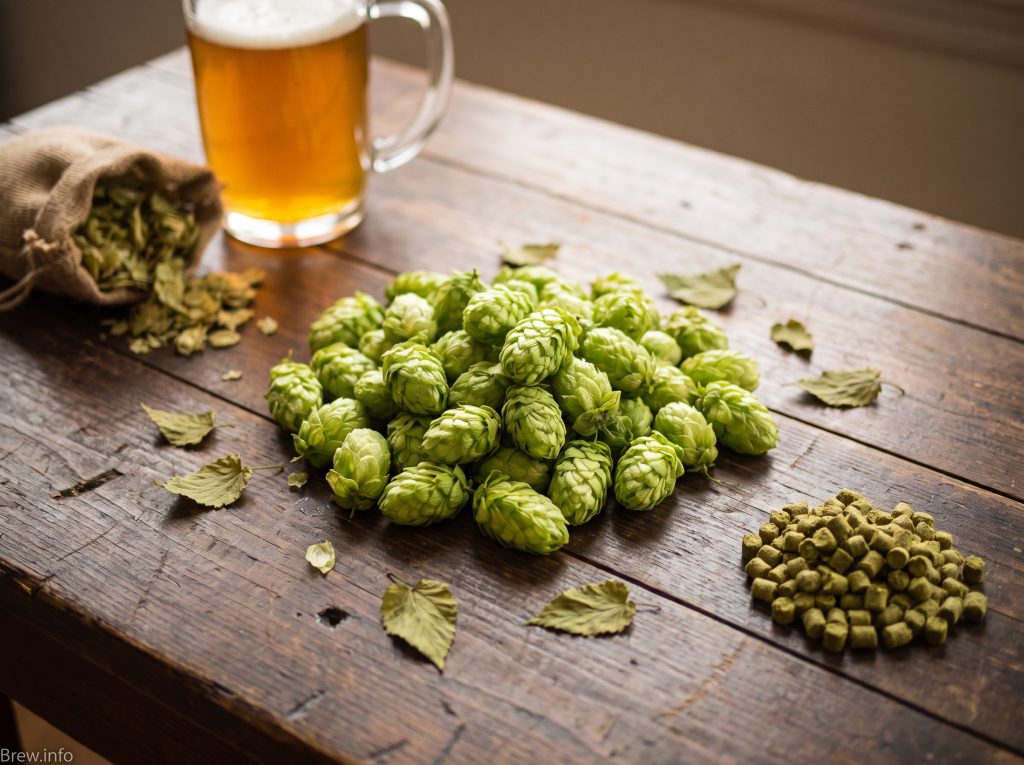
Centennial is an American dual purpose hop with bold lemon and floral character. Brewers often call it a super Cascade because it delivers a similar citrus profile with roughly double the bittering power. It’s a backbone hop in countless pale ales and IPAs.
Centennial at a glance
| Spec | Value |
|---|---|
| Origin | Washington, USA |
| Bred by | Washington State University |
| Released | 1990 (bred in 1974) |
| Purpose | Dual purpose, aroma and bittering |
| Alpha acids | 8.5 to 12% |
| Beta acids | 3.5 to 5.5% |
| Cohumulone | 23 to 30% of alpha acids |
| Total oil | 1.5 to 2.5 ml per 100 g |
| Myrcene | 45 to 75% of total oil |
| Humulene | 7 to 18% of total oil |
| Caryophyllene | 3 to 8% of total oil |
| Farnesene | Under 1% of total oil |
| Aroma | Lemon, orange, floral, orange blossom, light pine |
| Substitutes | Cascade, Columbus, Chinook, Amarillo |
Brewing values from Yakima Chief Hops. Values change from crop to crop, so always check the alpha acid on your package.
History and origin
Centennial took a long road from the breeding yard to brewery shelves.
- 1974: The original cross was made in the Washington State University breeding program.
- 1989: The variety was named for Washington’s state centennial, according to John I. Haas.
- 1990: Centennial was officially released to growers.
- 1990s and 2000s: It became a staple of the American IPA boom, prized for pairing with Cascade.
Its parentage is mostly Brewer’s Gold, with Fuggle, East Kent Golding, and other varieties in the mix. That blend of English and American genetics helps explain why it’s both bright and well rounded.
Aroma and flavor
Centennial leans toward lemon and floral. You’ll also get orange, a bit of orange blossom, and a light piney edge. It’s cleaner and more focused than the dank, resinous hops in the Columbus family, but punchier than Cascade.
Most of its oil is myrcene, which carries the bright citrus notes. That’s why late additions and dry hopping show it off best.
How to brew with Centennial
- Bittering: Centennial’s moderate cohumulone gives a fairly smooth bitterness, so it works well as a bittering hop in American ales.
- Late boil and whirlpool: A whirlpool addition at about 170°F for 15 to 20 minutes brings out its lemon and floral character.
- Dry hop: Use about 1 to 2 oz per 5 gallons for a pale ale and 2 to 4 oz for an IPA.
- Single hop beers: Centennial can carry a beer on its own. Bell’s Two Hearted is the proof.
- Freshness: Store pellets cold and sealed. Its citrus fades if the hops oxidize.
Tip: The Centennial and Cascade combo is a classic for a reason. Bitter with Centennial, then split your late additions between the two.
Best beer styles for Centennial
- American Pale Ale
- American IPA and West Coast IPA
- Double IPA
- American Amber Ale
- American Wheat Beer
- Hoppy Brown Ale
Hops that pair well with Centennial
| Pairing | What it adds |
|---|---|
| Cascade | Grapefruit and floral notes. The classic pairing |
| Chinook | Pine and spice for a sharper West Coast profile |
| Simcoe | Pine and passion fruit for depth |
| Citra | Tropical fruit to modernize the profile |
| Columbus | Dank, resinous bite for big IPAs |
Centennial substitutes
- Cascade: Similar citrus and floral notes with lower alpha acids. Use more for bittering.
- Columbus: Higher alpha and danker, but a reasonable bittering swap.
- Chinook: More pine and grapefruit, but works in IPAs.
- Amarillo: Softer and more orange, good for late additions.
Commercial beers that showcase Centennial
- Bell’s Two Hearted: An American IPA hopped entirely with Centennial and one of the most celebrated examples of the hop.
- Sierra Nevada Celebration: A fresh hop winter IPA that uses Centennial alongside Cascade and Chinook.
Brew with Centennial