
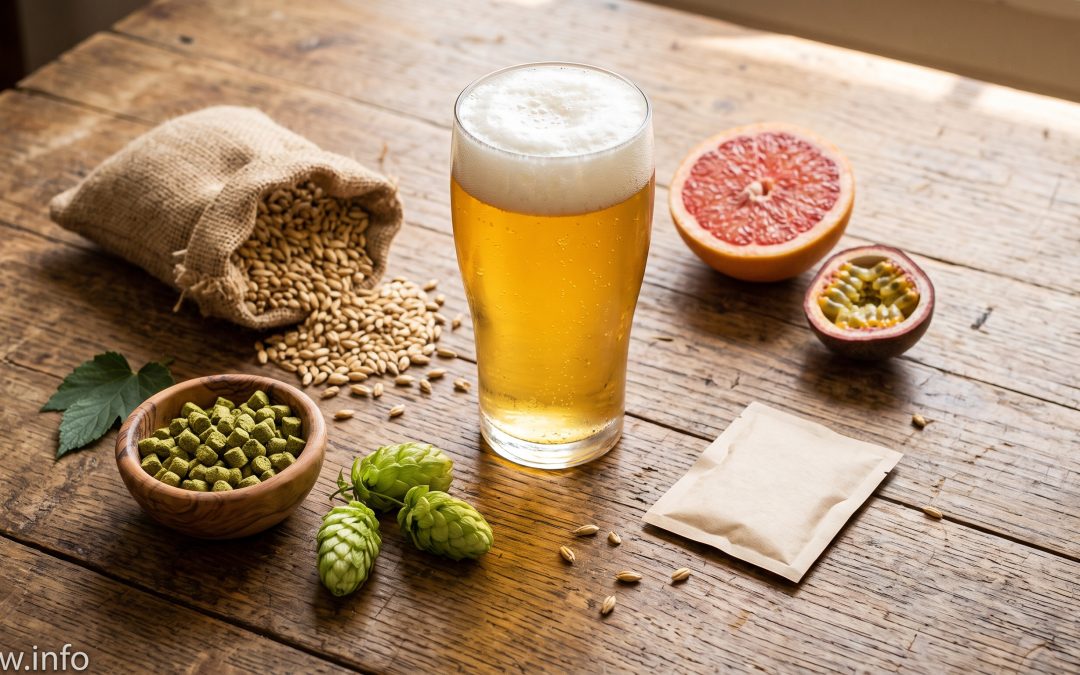
A great pale ale comes down to four ingredients working together: a clean pale malt, bright late-addition hops, a neutral ale yeast, and water that lets the hops pop. Get those right and the rest is technique.
Pale ale is one of those styles that looks simple on paper and still separates good brewers from great ones. There’s nowhere to hide. If the malt is too sweet, the hops get muddy. If the bitterness is too sharp, it stops being easy drinking. If the yeast throws off weird flavors, everyone notices.
The BJCP style guidelines for American Pale Ale sum up the ingredient approach nicely: neutral pale malt, American or New World hops, a neutral to lightly fruity ale yeast, and small amounts of specialty malt. The guidelines also credit Sierra Nevada Pale Ale, first brewed in 1980, with helping popularize the style. It’s still the benchmark most brewers point to.
Below, we break down the best options for each ingredient, explain what each one brings to the glass, and finish with the exact combination we used in our own Galaxy Citra Pale Ale.
The Malt: Build a Clean, Supportive Base
The malt’s job in a pale ale is to hold the hops up, not compete with them. Pick a base malt that matches the kind of pale you want, then use specialty grains sparingly. For a deeper look at how malt works, see our guide to understanding malt.
The 5 Best Base Malts for Pale Ale
| Base malt | Flavor | Best for |
|---|---|---|
| American 2-row | Clean, lightly grainy, neutral | Classic West Coast pales where hops lead |
| Golden Promise | Soft, slightly sweet, honey-like | Juicy, modern pales with fruity hops |
| Maris Otter | Biscuity, nutty, richer | English pales or fuller American versions |
| Pilsner malt | Light, crackery, delicate | Crisp, very pale, hop-forward beers |
| Vienna malt | Toasty, bread crust, golden | Blending in for depth and color |
American 2-row is the workhorse. It’s affordable, has plenty of enzymes, and stays out of the way. If you want the hops to be the whole show, start here.
Golden Promise is our pick for fruit-forward pales. This Scottish heritage malt produces a mellow, sweet, clean wort that makes tropical hops taste even juicier. Think of it as a cleaner, softer cousin of Maris Otter.
Maris Otter brings more bready, biscuity character. It’s great when you want the malt to have a voice without adding crystal malt.
Pilsner malt makes a very light, crisp beer. If you use a lot of it, do a 90 minute boil to drive off DMS, the compound behind that cooked corn note.
Vienna malt usually works best as part of the base. Swapping 20 to 50% of your base for Vienna adds a golden color and a light toasty note.
Specialty Grains: Less Is More
- Crystal malt (10L to 40L): Up to about 5 to 10% adds color and a touch of caramel. Go heavier and it can clash with fruity hops and make the beer taste sweet and muddy.
- Munich malt: A few ounces to half a pound adds depth and helps with color without much sweetness. Dark Munich gets you there with less.
- Flaked oats or white wheat: About 5% improves body and head retention. Oats also add a silky mouthfeel and haze, which suits juicier pales.
One tip worth knowing: an all-Golden Promise or all-Pilsner grist can land just under the BJCP’s 5 SRM color minimum. If you plan to enter competitions, a few ounces of Munich or light crystal will fix it.
The Hops: Where the Personality Comes From
Hops define a pale ale’s character, and the biggest wins come from late additions. Use a clean, high-alpha hop for bittering, then save your aromatic varieties for the whirlpool and dry hop. Our guide to hop varieties and usage covers the basics if you’re new to hop timing.
10 Great Hops for Pale Ale
| Hop | Origin | What it brings |
|---|---|---|
| Cascade | USA | Grapefruit, floral, light pine. The original APA hop |
| Citra | USA | Tropical fruit, lime, passion fruit, stone fruit |
| Mosaic | USA | Blueberry, mango, pine, a little earthiness |
| Centennial | USA | Lemon, floral, pine. A stronger take on Cascade |
| Simcoe | USA | Pine, passion fruit, a touch of dank |
| Amarillo | USA | Orange, apricot, soft floral |
| Chinook | USA | Pine, spice, grapefruit, firm bitterness |
| Galaxy | Australia | Intense passion fruit, peach, citrus |
| Nelson Sauvin | New Zealand | White wine, gooseberry, grape |
| El Dorado | USA | Pear, watermelon, candy-like stone fruit |
Citra has become the most widely grown hop in America for good reason. According to Yakima Chief Hops, its main aroma is tropical citrus and stone fruit with hints of lime and orange. It has enough alpha acid to bitter with, but most brewers save it for the whirlpool and dry hop, where its aroma really shines. Our Citra hop guide covers its history, alpha acids, and the best ways to use it.
Galaxy is Australia’s star aroma hop. BarthHaas describes it as punchy passion fruit, juicy peach, and tangy citrus, and recommends it for pale ales and IPAs. It’s powerful, so use it with a light hand. Even KegLand suggests going sparingly to avoid harsh flavors. For a deeper dive, Get Ollie’s Galaxy guide is worth a read.
Proven Hop Combinations
- Cascade + Centennial: The traditional American pale. Citrus and pine, very classic.
- Citra + Mosaic: Juicy and modern, with tropical fruit and a hint of berry.
- Simcoe + Amarillo: Bright orange citrus with a resinous backbone.
- Galaxy + Citra: A tropical fruit bomb. This is the combo in our recipe.
How to Use Them
- Bittering: A small charge of Magnum or Warrior at 60 minutes gives clean bitterness. Aim for about 30 to 45 IBU total.
- Whirlpool: Add aroma hops after the boil once the wort cools to about 170°F, and let them steep for 20 minutes. You get big flavor without harsh bitterness.
- Dry hop: About 2 to 3 oz per 5 gallons is plenty for a pale ale. Keep contact time to 3 or 4 days so hops like Galaxy don’t turn grassy.
The Yeast: Clean or Juicy, Your Call
Yeast decides whether your pale ale finishes crisp and dry or soft and fruity. For a classic pale, go clean. For a juicier, modern pale, pick a strain that adds a little fruit of its own.
| Yeast | Type | Profile | Ferment at |
|---|---|---|---|
| Safale US-05 | Dry | Clean, neutral, dry finish | 64 to 67°F |
| Wyeast 1056 / WLP001 | Liquid | Clean, neutral (same family as US-05) | 64 to 67°F |
| Wyeast 1318 London Ale III | Liquid | Soft, lightly fruity, fuller body | 64 to 68°F |
| Lallemand Verdant IPA | Dry | Soft and juicy, similar to London Ale III | 64 to 70°F |
| Safale S-04 | Dry | Light English character, clears fast | About 64°F |
US-05 is the go-to for most homebrewers. Fermentis calls it a neutral strain, and it delivers exactly that: a clean, crisp beer that lets the hops do all the talking. One 11.5 g packet handles a 5 gallon batch, no starter needed. Keep it in the mid-60s and it stays spotless.
London Ale III and Verdant IPA are the picks for a softer, juicier pale. They leave a bit more body and push the fruit forward. If you’re leaning into haze, check out our tropical yeast comparison.
S-04 is a solid choice if you want a slightly English twist. Ferment it cool, or it can get estery.
The Water: Small Tweaks, Big Payoff
Water is the ingredient most brewers skip, and it makes a noticeable difference in a hop-forward beer. The key players are sulfate and chloride.
- Sulfate sharpens hop bitterness and dries out the finish.
- Chloride rounds out the body and makes the beer feel softer.
For a crisp, classic pale, lean slightly toward sulfate, around 125 to 150 ppm sulfate and 50 to 75 ppm chloride. For a juicier pale, go closer to balanced. Brewer’s Friend has a good primer on how each mineral works, plus a calculator to dial in your additions. Starting from RO or distilled water makes this much easier, since you’re building the profile from scratch.
Aim for a mash pH of 5.3 to 5.4, and keep calcium in the 50 to 150 ppm range for healthy fermentation and good clarity.
Putting It All Together
Here’s the combination we landed on for our own tropical pale ale:
| Ingredient | Our pick | Why |
|---|---|---|
| Base malt | Golden Promise (91%) | Soft sweetness that makes fruity hops pop |
| Specialty grains | Dark Munich and white wheat (about 4.5% each) | Color, light bready depth, and head retention |
| Bittering hop | Magnum | Clean bitterness, no harshness |
| Aroma hops | Citra and Galaxy | Passion fruit, grapefruit, and peach |
| Yeast | Safale US-05 | Clean and dry, so the hops lead |
| Water | 125 ppm sulfate, 75 ppm chloride | Crisp finish without losing softness |
The result is a bright gold pale ale with big tropical aroma, a slightly sweet malt backbone with a light bready note, and a dry, snappy finish. It comes in around 5.8% ABV and 35 IBU, and every stat lands inside the BJCP guidelines for the style.
Ready to brew it? Get the full recipe, with the grain bill, hop schedule, water additions, and fermentation timeline, on HomebrewingRecipes.com: Galaxy Citra Pale Ale Recipe.
Author: Stu
Meet Brew.info's founder and head brewer, Stu. He began homebrewing as a hobby 13 years ago and has now made it a full-time career. He gives his advice, recipes, and reviews of equipment on Brew.info in an effort to encourage others to experience the satisfaction of homebrewing beer. You can find him trying out new breweries and beers, or unwinding at home with a pint of his most recent creation, when he isn't busy brewing or writing about beer. Cheers!


